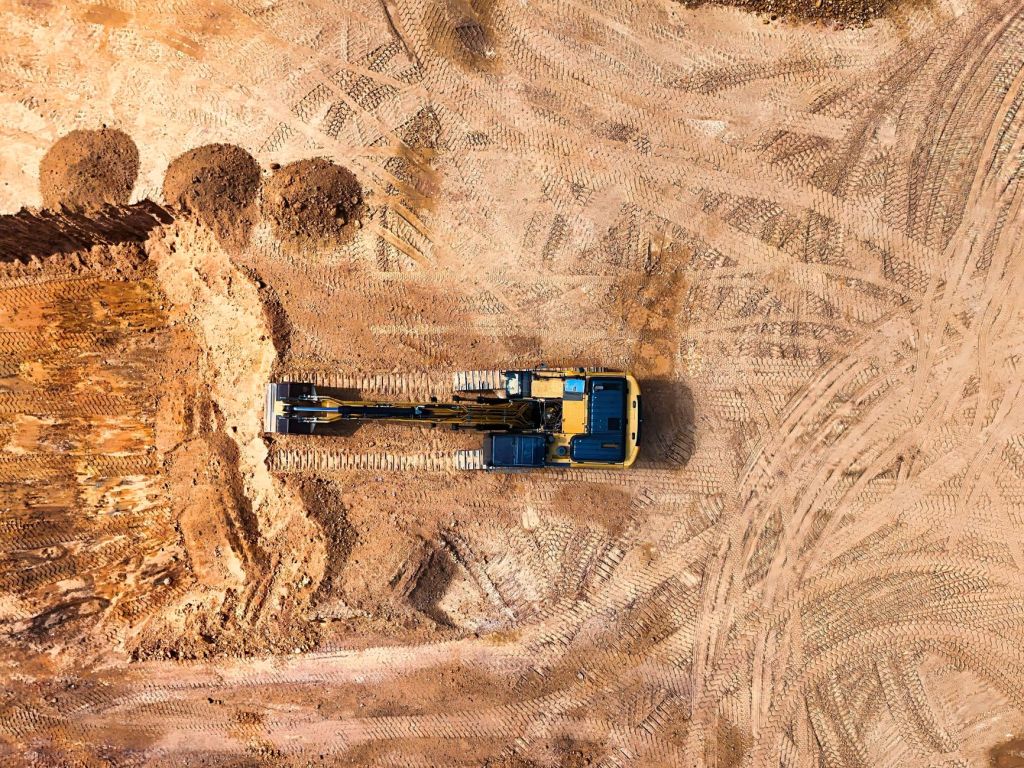
Long before a single pile is driven or a single foundation is poured, the ground itself often has to be reshaped. Earthworks — the excavation, movement, placement, and compaction of soil and rock to create a new ground profile — are among the oldest activities in civil engineering, and yet they remain one of the most technically demanding. A poorly executed earthworks operation can undermine everything built on top of it, however well the structural design has been conceived. Cuttings that are too steep, fill that is loosely placed, or ground left too wet to compact properly can all lead to settlement, instability, or outright failure long after the earthmoving plant has left site. This post looks at the fundamentals: how cut and fill volumes are balanced, why compaction matters, how moisture content governs the whole process, why layer thickness is specified so precisely, and how all of this is captured in an earthworks specification.
Cut and Fill
At its simplest, earthworks is about moving material from where there is too much of it — a cutting — to where there is too little — a fill — with the goal of achieving a designed final ground profile at the lowest practical cost. On a linear scheme such as a road or railway, this balancing act is visualised using a mass haul diagram, which plots the cumulative volume of cut and fill against chainage along the route. A well-designed alignment aims to balance cut and fill as closely as possible, minimising the volume of material that must be imported from a borrow pit or exported to a tip, since haulage is one of the most expensive components of any earthworks contract.
Balancing a mass haul diagram is rarely as simple as matching raw excavated and placed volumes, because soil changes volume as it is disturbed and re-compacted. Bulking describes the increase in volume that occurs when intact ground is excavated and its structure is disturbed, loosening the particle arrangement. Shrinkage describes the reduction in volume that occurs when that same loosened material is subsequently recompacted into a fill, often to a higher density than it had in its original, undisturbed state. Bulking and shrinkage factors, usually derived from experience with similar materials or from trial earthworks, must be applied to convert measured cut volumes into the equivalent placed fill volume, and getting them wrong can leave a contractor with an unexpected shortfall or surplus of material partway through a job.
Haul distance and haul route also weigh heavily on the economics and programme of an earthworks scheme. Short hauls within a single cut-to-fill operation are far cheaper than long hauls to a distant borrow area or disposal site, and the choice of plant — dump trucks, scrapers, or conveyors — depends heavily on the distances and volumes involved. Where a scheme cannot be balanced on site, surplus material must be taken to licensed disposal facilities, and additional fill must be won from a borrow pit or imported aggregate source, both of which carry cost, carbon, and planning implications that increasingly shape how earthworks are designed from the outset.
Compaction
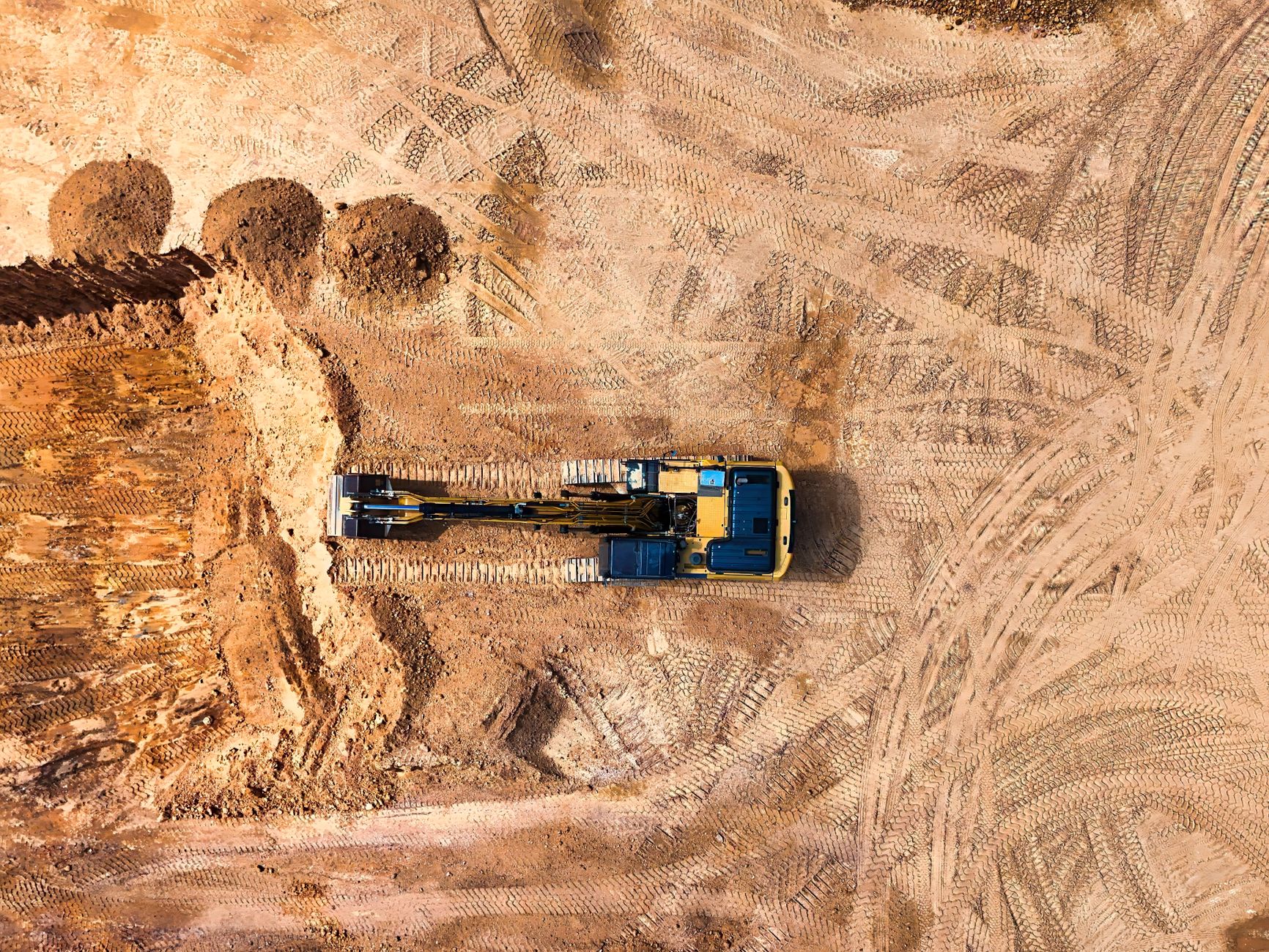
Once material has been placed, it must be compacted. Compaction is the process of increasing the density of soil by mechanically forcing air out of the voids between particles, and it is arguably the single most important activity in any earthworks operation. Well-compacted fill has higher shear strength, higher stiffness, lower compressibility, and lower permeability than the same material placed loosely, and all of these properties translate directly into a more stable and durable finished earthwork, whether that is an embankment, a pavement subgrade, or backfill around a structure.
The relationship between compaction effort, moisture content, and the density achieved is described by the compaction curve, first established through the Proctor test developed in the 1930s. For any given soil and compactive effort, there is an optimum moisture content at which the maximum dry density is achieved: too dry, and friction between particles prevents them being pushed into a dense arrangement; too wet, and water occupies void space that would otherwise be filled by solid particles, while pore pressures can develop that resist compaction. The standard and modified Proctor tests, along with their British equivalents, remain the reference tests against which field compaction is judged.
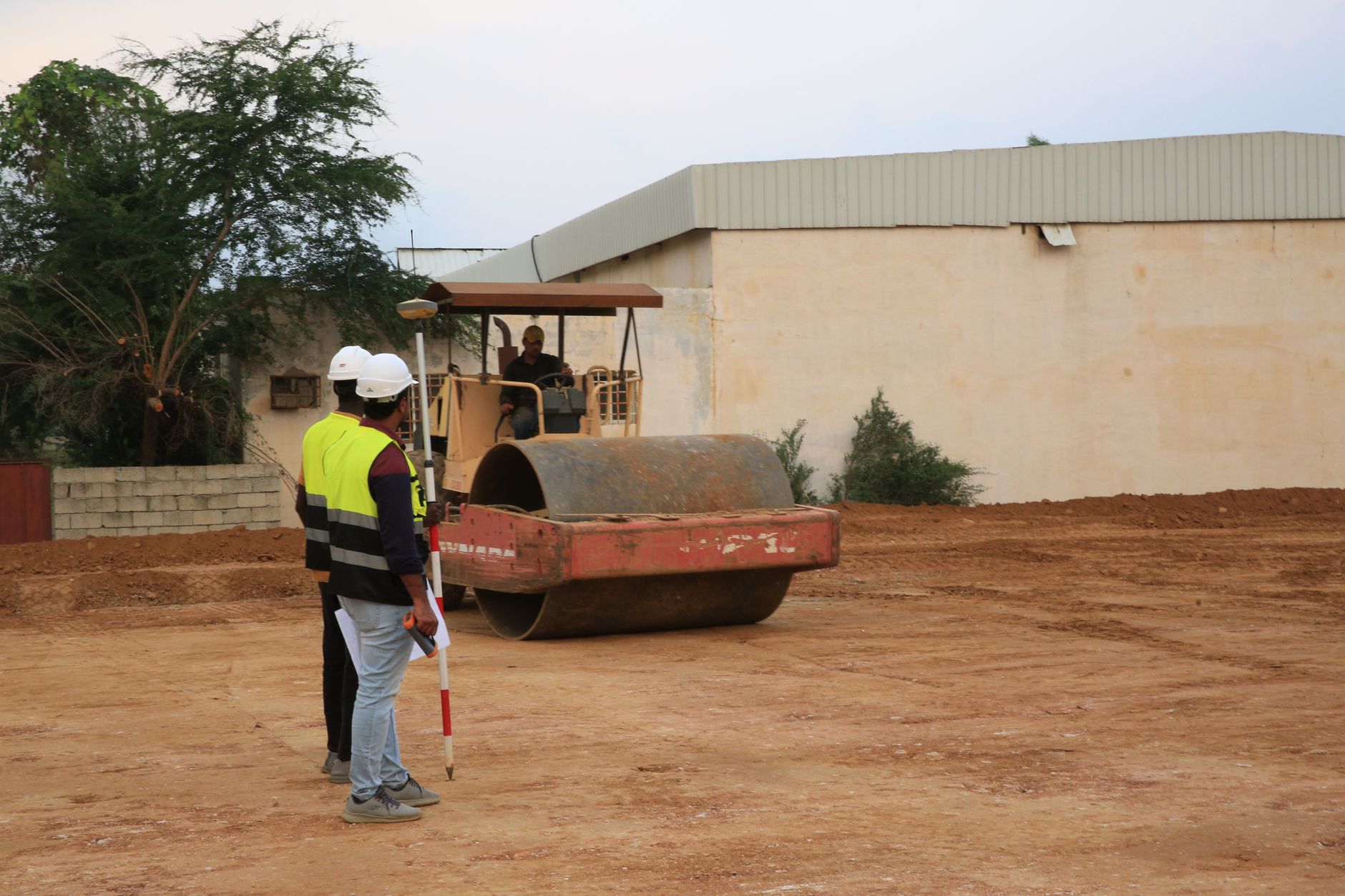
Achieving adequate compaction in the field requires the right plant for the material. Smooth-drum rollers are effective on granular soils and rock fill, using mostly static or vibratory weight to rearrange particles into a denser configuration. Sheepsfoot and padfoot rollers, with their protruding feet, are better suited to cohesive clays, where they knead and remould the soil, breaking down clods and working out air voids from the bottom of the layer upwards. Pneumatic-tyred rollers provide a kneading action useful for granular and some cohesive materials alike, and vibrating plates and trench rollers handle compaction in confined spaces such as pipe trenches where large rollers cannot operate. The number of passes required, and the layer thickness that can be effectively compacted, both depend on the mass and type of roller being used.
Moisture Conditioning
Because compacted density is so sensitive to moisture content, controlling the water content of fill material — moisture conditioning — is central to earthworks quality. Material arriving on site rarely sits exactly at its optimum moisture content, and the weather rarely cooperates by keeping it there. Material that is too wet must be dried, typically by spreading it out and allowing it to aerate, or by discing and turning it to expose fresh surfaces to the air and sun. Material that is too dry must be wetted, usually using water bowsers with spray bars that add a controlled quantity of water across the surface of a layer before it is worked in and compacted.
Cohesive soils are particularly sensitive to moisture content because their behaviour changes markedly on either side of optimum. Material placed wet of optimum tends to be weaker, more compressible, and more likely to generate excess pore water pressure under subsequent loading, even though it may compact to a reasonably high density. Material placed dry of optimum can be stiffer initially but prone to softening and swelling if it later takes up water in service. For this reason, UK earthworks practice makes extensive use of the Moisture Condition Value (MCV) test, developed by the Transport Research Laboratory, which provides a rapid field measure of the effort required to compact a soil to near-refusal and correlates well with suitability for use as fill without needing a full moisture-density relationship for every sample.
Because moisture conditioning is so weather-dependent, earthworks programmes in the UK are inevitably seasonal, with the summer months offering far more reliable conditions for handling cohesive fill than the wet winter period, when many contracts switch to granular or imported material, or pause moisture-sensitive operations altogether.
Layer Thickness
Compaction plant cannot compact an unlimited depth of material in one pass; the compactive energy delivered at the surface attenuates with depth, so soil is placed and compacted in a series of relatively thin layers rather than as a single deep fill. Specifying the correct loose layer thickness for the plant and material in use is essential to ensuring that compaction is effective right through the layer, rather than leaving an under-compacted zone near the bottom that later settles or fails under load.
Typical loose layer thicknesses for cohesive general fill compacted with a heavy roller might range from around 150 to 300 millimetres, while well-graded granular fill can often be placed and compacted in somewhat thicker layers. Rockfill, where large particle sizes make thin layers impractical and unnecessary, is frequently placed and compacted in layers of 500 to 600 millimetres or more, using heavy vibrating rollers to achieve the necessary interlock and density between the larger fragments. These figures are only indicative; the appropriate layer thickness for a given material and plant combination is normally established and confirmed by a compaction trial before full-scale earthworks proceed.
Layer thickness, roller mass, vibration frequency, travel speed, and number of passes are all interrelated, and method specifications typically define combinations of these parameters that have been demonstrated to achieve the required end result. Exceeding the specified layer thickness — sometimes done informally on site to speed up production — is one of the most common causes of under-compaction, and it is precisely the kind of shortcut that quality assurance and inspection on site is there to catch before it is buried under the next layer and becomes invisible to everyone but the ground itself.
Earthworks Specifications
All of the concepts above — cut and fill balance, compaction, moisture conditioning, and layer thickness — are drawn together in the project earthworks specification, the document that defines how earthworks must be carried out and how compliance will be judged. In the UK, the most widely used reference is the Specification for Highway Works, Series 600, which classifies fill materials into numbered classes according to their type and intended use, from general granular and cohesive fills through to selected fills for specific applications such as capping, structural backfill, and fill around buried structures.
Earthworks specifications generally follow one of two philosophies. A method specification prescribes exactly how the work must be done — the plant type, layer thickness, and number of passes — leaving the contractor with little discretion but also, in principle, little risk if the prescribed method is followed faithfully. An end-product specification instead defines the properties the finished fill must achieve, typically a minimum percentage of a reference maximum dry density, or a minimum stiffness or strength value, leaving the contractor free to choose the means of achieving it. End-product specifications offer more flexibility and can reward efficient working, but they require robust testing to confirm compliance, since there is no prescribed method to fall back on as evidence of adequate work.
Increasingly, specifications for earthworks are moving beyond simple density-based acceptance criteria towards approaches that more directly assess the engineering properties that actually matter for performance, such as strength and stiffness, recognising that density alone does not always guarantee that a fill will behave as intended in service. Whatever philosophy is adopted, a specification is only as good as the quality assurance regime that sits behind it: the sampling, testing, and verification that confirms, layer by layer, that what has gone into the ground actually meets the standard that was specified on paper. That testing and verification process — construction quality assurance — is itself such a large topic that it deserves a post of its own, which is exactly where we turn next.
Earthworks may lack the visible glamour of the structures that are eventually built upon them, but they are every bit as much an engineering discipline as structural design, demanding a firm grasp of soil mechanics, plant capability, and site management working together. Getting the cut and fill balance right saves money and carbon; getting compaction and moisture conditioning right delivers a fill that will not settle or fail; and getting layer thickness and specification right provides the framework that ties the whole operation together and makes it verifiable. The ground an engineer inherits at the start of a scheme is rarely the ground that is needed at the end of it — earthworks is how one becomes the other, safely and predictably.


Leave a Reply